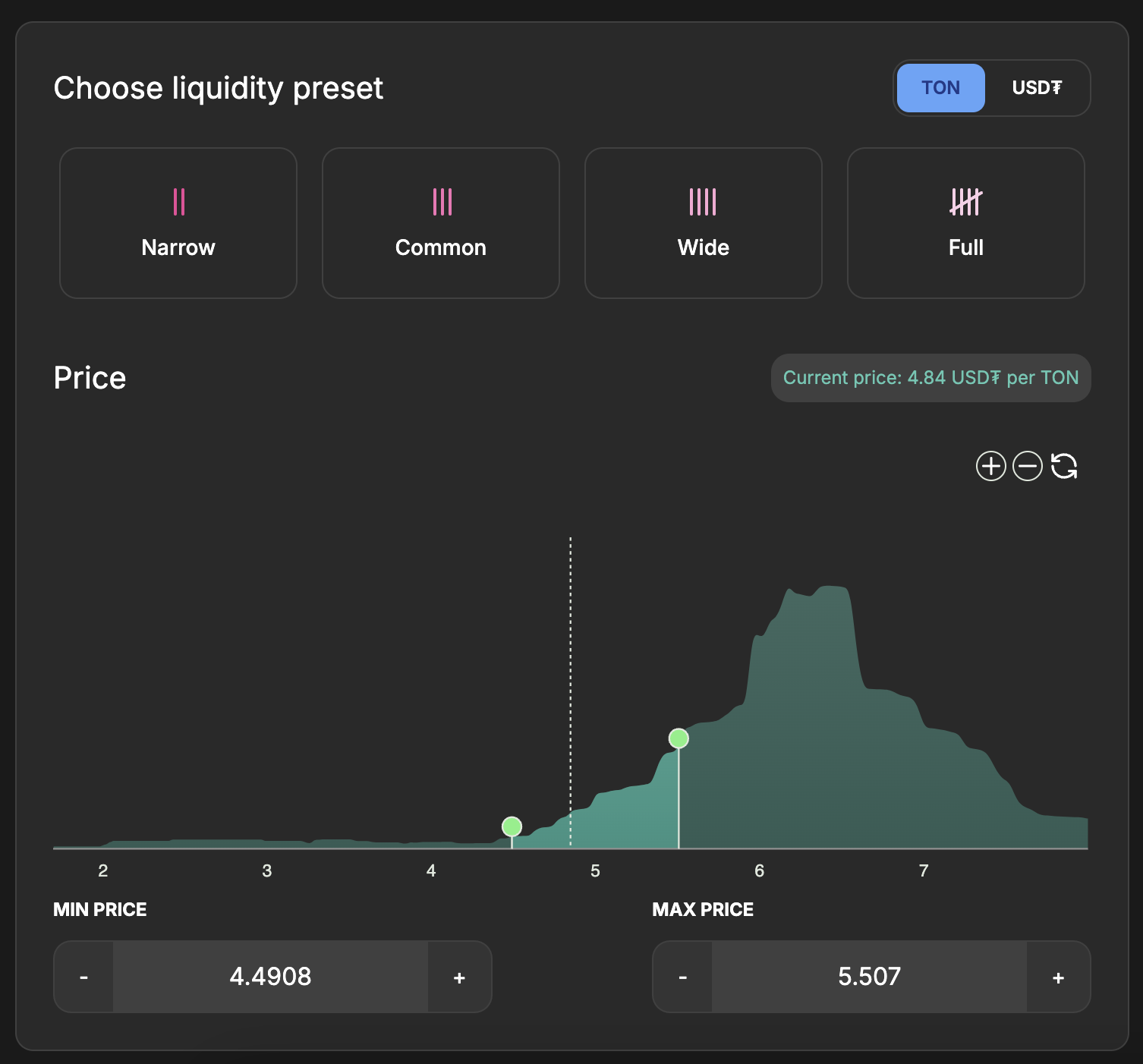
Hedging with Storm Trade (Perp DEX)

Storm Trade x TONCO DEX hedging strategy
An alternative way to hedge your LP position using lending platforms is by short-selling the volatile asset via margin trading on Storm Trade, which allows leverage up to x75 on GRAM/USDT pair.
This method is less capital-intensive compared to using lending, as DeFi lending requires overcollateralized loans. With short-selling on Storm, you can use margin as collateral, meaning you don’t need as much initial capital to open your position.
This makes it a more flexible option for hedging, especially if you want to avoid locking up significant funds in collateral. However, the downside of this approach is the risk of liquidation. If you’re using a high leverage, a small price movement against your position can lead to a liquidation, causing you to lose your collateral.
Example
You have $15,000 and want to open a position in the GRAM/USDT pair on TONCO DEX. Assuming the APR for a GRAM/USDT pair is 100% and Gram (prev. Toncoin) is traded at 5 USDT.
You put 1500 GRAM and 7,500 USDC into a liquidity pool on TONCO DEX. Let's say you put range between 4.5 and 5.5. As long as the GRAM price stays within your designated range, you’ll earn trading fees.
One day, the price of GRAM drops beyond your range to 4 USDT. You end up with a position consisting of ≈ 3,060 GRAM (as the ratio changes along the way, you end up with slightly more than 2x GRAM) and 0 USDT. You are now fully exposed to the GRAM price and experience permanent loss.
After selling the tokens received for providing liquidity for 30 days while being in-range, the cumulative yield stands at 1,232 USDT (calculated as 7,500 * 2 * 100% / 365 * 30). You decide to stop providing liquidity.
If you sell the 3,060 GRAM at 4 USDT each and combine the proceeds with the 1,232 USDT, you’ll see a total loss of 1,528 USDT or ((3,060 * 4 + 1,232) - 7,500 * 2) due to impermanent loss.
Hedging vs. No Hedging
• Without Hedging
If you had opened the original position without any hedging ($15,000: 7,500 USDT + 1,500 GRAM), you would have ≈3,060 GRAM and 0 USDT. If you decide to lock in your loss and withdraw 3,060 GRAM, you would receive:
— 3,060 * 4 = $12,240 (if the price of GRAM dropped to $4)
— Trading fees ($1,232 from the example above)
The total would be:
$12,240 + $1,232 = $13,472, a -10.18% loss
• With Hedging on Storm Trade (the downside risk on price decrease)
We use 5,000 USDT as collateral and open a short position for 1,000 GRAM (assuming GRAM = $5). No leverage is used in this example, but it can be adjusted according to your risk tolerance.
You can set a stop loss at the minimum tick of your price range on TONCO to protect against a significant price rise. This ensures the position on Storm Trade closes if the price moves unfavorably.
After the GRAM price drops to $4 you withdraw ≈2,040 GRAM from TONCO. But since TON’s price dropped, the short position you opened on Storm Trade became a profitable trade for you. You should profit 1,000 USDT (1,000*1) after closing the short position and withdraw initial 5,000 USDT collateral back.
You have to pay $6 service fee (0.12% of the position size).
But your earn additional $189 from positive funding rates over 30 days (assuming a 2.52% additional yield from the funding rate of 0.0035% per hour; as for Dec 19th).
The total would be:
— $8,160 (from the sale of 2,040 GRAM at $4)
— $1,000 (profit from short position)
— $5,000 (collateral returned)
This gives you:
$8,160 + $1,000 + $5,000 = $14,160, plus:
— Trading fees ($1,232 from the example above)
— Funding rate profit: $183 (net profit from the positive funding rate minus service fees)
Grand total:
$14,160 + $1,232 + $183 = $15,575, a +3.82% profit
This means that by hedging, you have completely mitigated the loss from the drop in the GRAM price and made a profit from the position.
Step-by-step strategy for hedging
Here’s a step-by-step strategy for hedging the downside risk of a GRAM price decrease.
There is a symmetrical strategy that aims to protect the gains in case the asset price goes up. Instead of shorting GRAM, you’d long it.
1. Open a Short Position
Use 5,000 USDT as collateral on Storm Trade to open a short position for 1,000 GRAM (assuming GRAM = $5). You can place a stop loss at the minimum of your price range to protect against price increases.
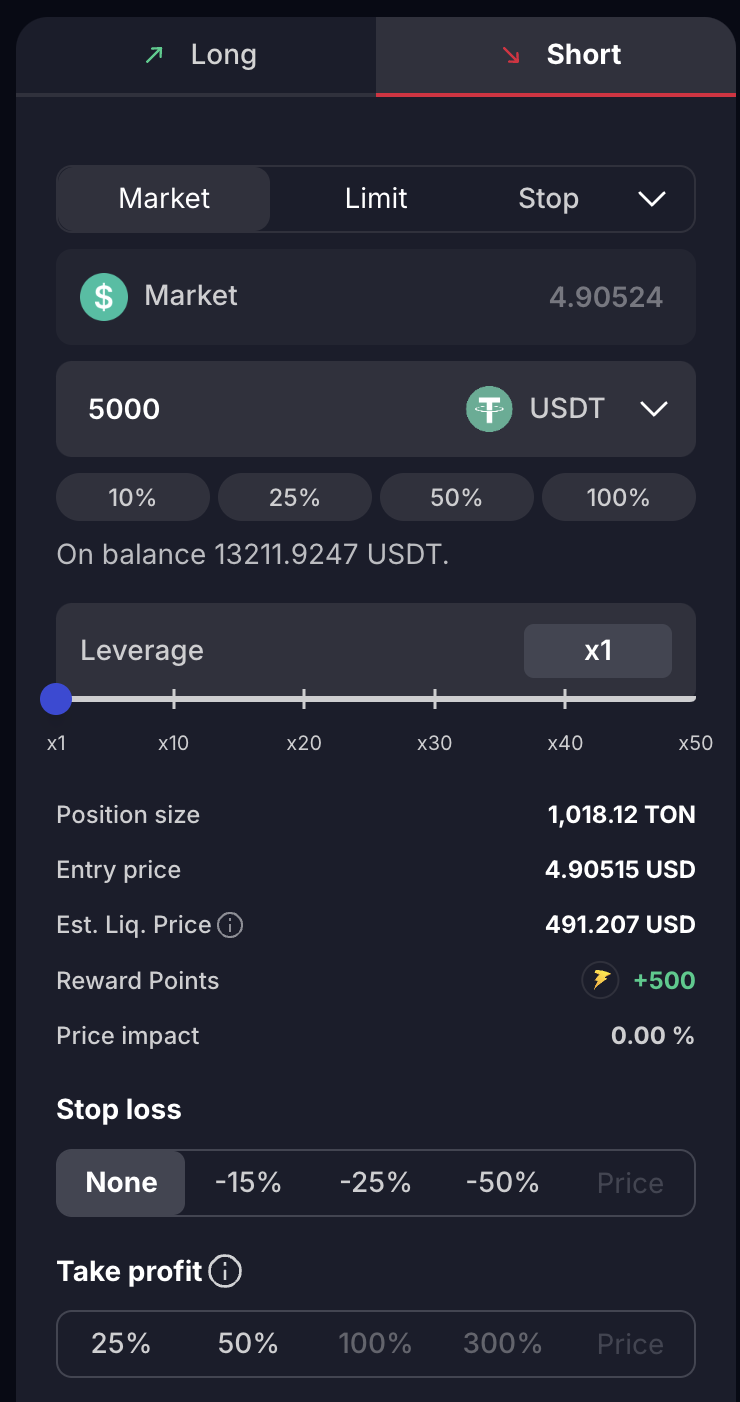
Shorting GRAM on Storm Trade
2. Open LP position on TONCO
Provide liquidity with $5,000 USDT and 1,000 GRAM on TONCO DEX.
This brings your total position value to $10,000.